
Cost of Selling a House in Canada


Cost of Selling a House in Canada
Cost of Selling a House in Canada: Inherited Property Guide (2026)
Inheriting a home can be emotional, but it also comes with financial questions. If you're an executor, you need to understand the cost of selling a house from an estate. This guide breaks down the complex legal and tax hurdles.
Estate-Specific Administrative and Legal Fees
You must complete the financial steps necessary to transfer its ownership from the deceased to the estate. Before proceeding further, you may use our Free Home Evaluatio n tool to estimate the current market value of the inherited property
Probate Fees and Estate Taxes
As of 2026, probate fees , also known as the Estate Administration Tax, vary by province. For example:
- Ontario charges $5 for every $1,000 of the first $50,000 of estate value and $15 for every $1,000 above that. This means a $500,000 estate would owe $7,000, while a $2 million estate would owe $29,500.
- Alberta has a capped probate fee of just $525.
These fees affect the total cost of selling and must be paid before the court allows you to sell the property.
Executor Compensation
Executors can claim a percentage of the estate’s value. This payment should be included in the total selling costs.
Estate and Real Estate Legal Expenses
You will inevitably face legal costs when selling a house during probate. You must understand that these estate legal fees are entirely separate from standard real estate legal fees. This answers the common question of who pays legal fees when selling a house: the estate does.
The Tax Implications: Understanding "Deemed Disposition"
Canada does not have an inheritance tax, but the "Deemed Disposition" rule applies.
The Principal Residence Tax Exemption
The principal residence tax exemption can shield an estate from capital gains taxes if the home was the deceased's primary residence, significantly reducing the fees for selling a home.
Post-Death Capital Gains
If the property's value increases between the date of death and the sale, the estate must pay capital gains tax on that increase. This adds to the overall house-selling fees and the cost of selling a home.
Comparing the Cost of Selling a House: As-Is vs. Renovated Estate Sales
The cost of selling a house is affected by its physical condition. Many inherited homes have not been updated for many years. To better prepare for the selling process, review our Tips for Home Selling guide to avoid delays and costly mistakes.
The "As-Is" Sale Approach
Selling an older home "as-is" is a common choice. You will have almost no upfront costs, but the sale price may be lower, and buyers may negotiate harder, which can increase the real cost of selling.
How much does it cost to sell a home after updates?
Things like painting, roof repairs, and kitchen updates require upfront costs, which the estate may not have.
Making the Right Choice
To help you decide, see the comparison table below:
Table Header: Estate Strategy Comparison: The Real Cost of Selling a House in Canada
Selling Strategy | Upfront Costs | Time to Sell | Final Sale Price | Net Proceeds to Estate |
Selling As-Is | Very Low | Fast | Lower | Moderate (Fewer expenses) |
Minor Updates | Moderate | Moderate | Higher | High (Best return on investment) |
Full Renovation | Very High | Slow | Highest | Variable (Depends on renovation costs) |
Calculating Closing Costs When Selling a House
A Free Home Evaluation can help you estimate realistic selling prices before calculating commissions and fees.
Canadian Real Estate Agent Commissions
Canadian real estate agent commissions typically range between 3% to 5% of the sale price. You may also reduce overall costs through 1.5% cashback on buying and selling homes, helping improve net estate returns
Standard Closing Fees for Seller
Prepare yourself for standard closing costs that include mortgage discharge penalties, utility adjustments, and professional staging costs. If you are handling an estate in Toronto or Ottawa, you need to calculate specific closing costs when selling a house in Ontario.
Total Expense Breakdown
To figure out the cost of selling a house in Ontario or another province in 2026, add up the following:
- the probate fees (in Ontario: $5 per $1,000 on the first $50,000 of estate value, then $15 per $1,000 above $50,000),
- executor compensation,
- legal fees for selling the home.
- potential capital gains taxes (50% inclusion rate remains in place for the first $250,000 of gains),
- Canadian real estate agent commissions (typically 3–5% of sale price),
Table Header: Calculating the Total Cost of Selling an Inherited House in Canada
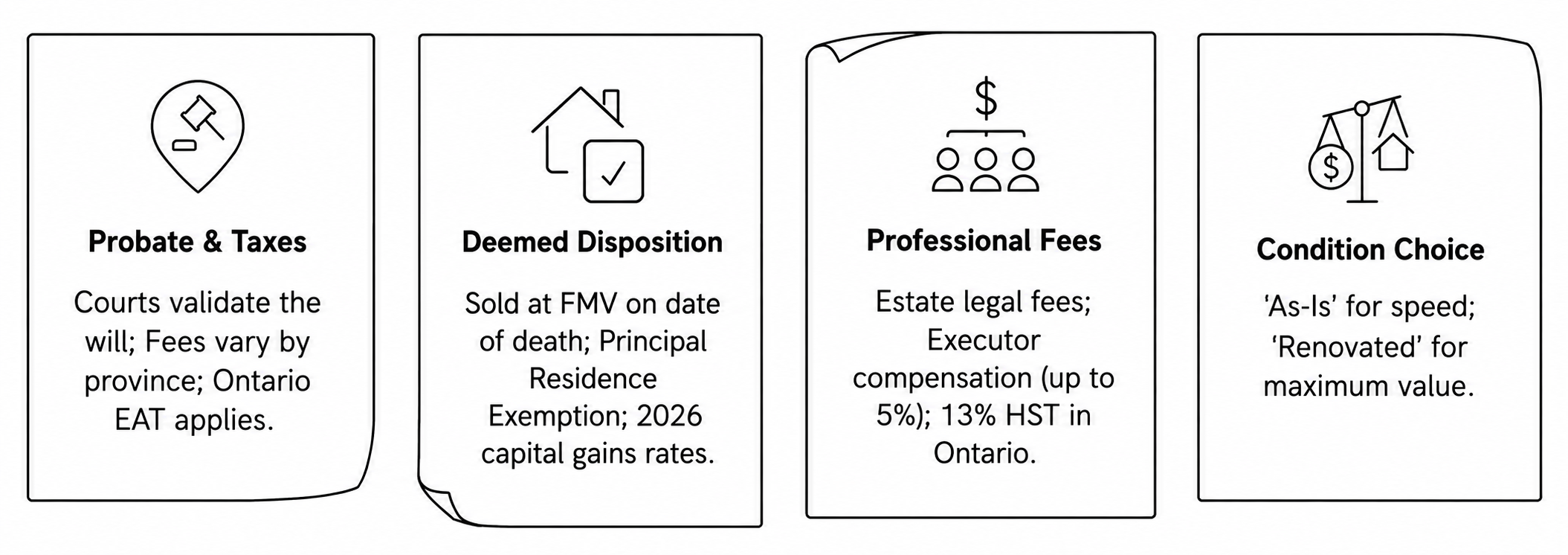
Table Footer: Navigating these 2026 tax rules and Ontario probate fees requires expert planning to protect your inheritance. Contact Serik Realty for a personalized estimate of the closing costs when selling a house in Ontario .
Get a Personalized Cost Valuation of your Inherited Property
Selling an inherited home involves estate fees, taxes, and real estate costs. Consult with an estate lawyer and a Serik Realty real estate professional to get a clear, personalized estimate of the costs for your situation.
Frequently Asked Questions
- How much are closing costs on an inherited house?
Closing costs for an inherited house depend on probate fees, executor compensation, legal costs, real estate commissions, and potential capital gains taxes.
- Is probate mandatory for an inherited home?
Yes, most provinces require probate to validate the will before the property can be sold, which adds to the estate settlement costs.
- What are the legal fees for selling an inherited house?
Legal fees for selling an inherited house in Canada typically range from $1,000 to $2,500, depending on the province and complexity.
- How does Deemed Disposition affect selling a house?
Deemed disposition triggers a potential capital gains tax liability for the estate upon the owner's death, increasing the total cost before the home is officially sold.
- Should I sell an inherited home as-is?
Selling "as-is" saves time and money upfront but may lower the sale price. Renovating could increase its value, but requires an initial investment.
- Who pays the legal fees for selling an inherited house?
The estate pays all selling costs, including legal fees and real estate commissions, from the sale proceeds before distributing funds to beneficiaries.
- What are the closing costs for a house in Ontario?
In Ontario, closing costs are typically 4–7% of the home's sale price, including real estate commissions and legal fees.
- Can I sell a house before probate?
No, an inherited home cannot be legally sold or transferred in most Canadian provinces until probate is granted.